Master’s Course Reflections

Month 2: Strategies for Learner Engagement with Dr. Reo McBride

  1. How has each course contributed to your personal and professional development as an instructional designer? 

This course helped me revisit various pedagogical concepts that I had been using as a teacher and initiative coordinator. The SWOT analysis at the end of the course gave me the opportunity to do a deeper internal analysis. This in of itself is important to do periodically to reevaluate where I am at as an individual and professional.

  1. How well were you able to utilize the concepts and techniques you learned from the program (theories, systems design, interface styling, and the creation of multimedia content) as you designed, developed, and implemented your Capstone Project? 

Many of the concepts and the techniques covered in Strategies for Learner Engagement were ones that I had known previously from education degree, trainings, and teaching experience. The time to focus on them was valuable in expanding my knowing, which I used as a basis for my Capstone Project.

  1. Describe your most outstanding personal triumph in each course.

My personal triumph for this course was maintaining focus and motivation as much of the information I already knew through my previous education and experience. 

Month 3: Visual and Verbal Communication in Instructional Design with Professor Eric Bunner-Sorg

  1. How has each course contributed to your personal and professional development as an instructional designer? 

This course introduced me to what would become one of my favorite takeaways for Full Sail’s Master’s program, Adobe XD. Within this course I was able to take my prior knowledge and experience and enhance it through the use of various asset creation tools. This would prove to lay a foundation for the rest of my time at Full Sail University. 

  1. How well were you able to utilize the concepts and techniques you learned from the program (theories, systems design, interface styling, and the creation of multimedia content) as you designed, developed, and implemented your Capstone Project? 

For my Capstone Project I developed an interactive app prototype using Adobe Illustrator, Photoshop, and XD. I also incorporated learning theories such as SAMR and Situated Learning Theory. When designing the visual elements of my Capstone Project I also utilized the information I had acquired about visual design, fonts, and colors to make sure that I had the most visually appealing and engaging asset possible. 

  1. Describe your most outstanding personal triumph in each course.

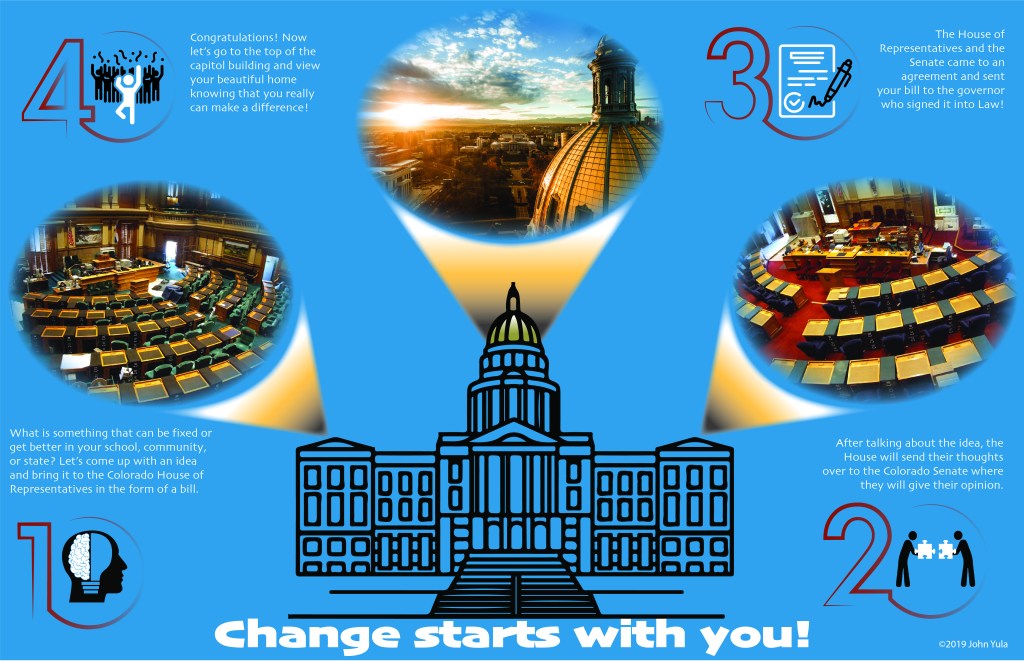
My biggest personal triumph was the asset I created in Adobe XD which was designed to teach how the state government functions within Colorado. After the conclusion of the class I shared the asset with a former colleague of mine, who is still an active teacher. He was able to use the asset and provided extremely positive feedback from both himself and his students regarding the practical use of the e-Learning module.

Month 4: Corporate Training and Motivational Development with Professor Eric Bunner-Sorg

  1. How has each course contributed to your personal and professional development as an instructional designer? 

This was the single most enjoyable, and valuable course within the entirety of the Instructional Design and technology master’s program. Corporate Training and Motivational Development helped me grow both personally and professionally through teaching me what the real-world applications of being an Instructional Designer would be like. I worked as hard as I could to try and simultaneously create and solve a complex set of client issues. By the end of the course I had developed a range of assets that could be used to improve the overall quality of my client’s business.

  1. How well were you able to utilize the concepts and techniques you learned from the program (theories, systems design, interface styling, and the creation of multimedia content) as you designed, developed, and implemented your Capstone Project? 

In my Capstone Project I took the lessons learned from entirety of the Purrfectionary project and incorporated them into the app design. I fully intend on pursing the development of my Capstone Project and part of that is due to its practical application and taking into consideration different obstacle that could potentially arise. 

  1. Describe your most outstanding personal triumph in each course.

My biggest personal triumph within Corporate Training and Motivational Development was being the recipient of a Course Director award. The final project as a whole really helped expand my abilities and show me what all being an actual instructional designer would entail. It helped me realize and confirm that this is what I want to do for a living for the rest of my life.

Month 5: Instructional Design and Evaluation with Dr. Chris Deason

  1. How has each course contributed to your personal and professional development as an instructional designer? 

This course helped me grow in an extremely important manner both personally and professionally. The course was a stark contrast from the previous one and helped me to remind me, as well as reaffirm the importance of doing your best. The most important reason for me to do my best is because it is a representation of me. While I may not agree with my client, how they want things done, or feel as though they degrade the quality of my work it is still important to persevere and complete the tasks at hand.

  1. How well were you able to utilize the concepts and techniques you learned from the program (theories, systems design, interface styling, and the creation of multimedia content) as you designed, developed, and implemented your Capstone Project? 

The information that I was able to utilize from this course in my Capstone Project was research I completed on the SAMR model, which I has always been an obsession of mine.

  1. Describe your most outstanding personal triumph in each course.

For me, the most outstanding personal triumph was completing a high-quality set of products, despite the obstacles put in front of me by my “client”. My biggest struggle was the fact that my style, personalization, and work felt as though it was taken away from me. I had to learn to be malleable in my approach and complete work as the client wanted it done, even if I would never personally do it that way.

Month 6: Digital Media and Learning Applications with Dr. Reo McBride

  1. How has each course contributed to your personal and professional development as an instructional designer? 

Coding is something that I have always had a personal interest in. Professionally, I think that having a base understanding of how coding works is important and increases my versatility. 

  1. How well were you able to utilize the concepts and techniques you learned from the program (theories, systems design, interface styling, and the creation of multimedia content) as you designed, developed, and implemented your Capstone Project? 

The concept of learners having an active role was a driving element during the design of my final app’s prototype. 

  1. Describe your most outstanding personal triumph in each course.

During the coding of the interactive quiz, I ran into a variety of technical issues. My perseverance throughout it all was my personal triumph. I could not find the answers despite checking a variety of avenues. After a lot of testing and reaching out to my peers I was able to fix my quiz and create an engaging, interactive quiz.

Month 7: Music and Audio for Instructional Design with Dr. Chris Deason

  1. How has each course contributed to your personal and professional development as an instructional designer? 

There were a few contributions that Music and Audio for Instructional Design made to my personal and professional development. Professionally, the newfound skills in audio editing have proven to be and will continue to be invaluable across the widest range of assets I develop. Whether it be producing video content, tutorials, audio, or editing client content the skills I developed will be used. Also, this class was largely self-taught on two fronts. The lack of direction forced me to be self-driven in my endeavors and if it were not for the addition of peer feedback, the entirety of the process would have had no outside assistance. Also, similar to in a few other courses, when issues arose, and I asked for assistance I was given none. I had to search across a multitude of mediums to find the solution to my problems which will prove to be a valuable skill in the future.

  1. How well were you able to utilize the concepts and techniques you learned from the program (theories, systems design, interface styling, and the creation of multimedia content) as you designed, developed, and implemented your Capstone Project? 

In the demo video for my Capstone Project I had to record and edit the voiceover. I use the skills I developed in Music and Audio for Instructional Design to produce the cleanest, and most professional asset possible.

  1. Describe your most outstanding personal triumph in each course.

My biggest triumphs came my self-driven, perfectionist nature. When facing adversity within the course I put in the time and effort to fix any issues that arose and create an asset that would be one of the best from the whole program.

Month 8: Filmmaking Principles for Instructional Design with Dr. Sharon Wyly

  1. How has each course contributed to your personal and professional development as an instructional designer? 

One of the most difficult parts of the development process for me is planning and organizations. Learning how to create more detailed, and succinct storyboards will be helpful when making videos in the future. 

  1. How well were you able to utilize the concepts and techniques you learned from the program (theories, systems design, interface styling, and the creation of multimedia content) as you designed, developed, and implemented your Capstone Project? 

For the demo reel of my Capstone Project I created a storyboard to help organize and streamline the recording process

  1. Describe your most outstanding personal triumph in each course.

Personally, I found myself experimenting with more angles and editing techniques than I would have otherwise. The success that I saw with them encourages me to continue with the experimentation in the future.

Month 9: Game Strategies and Motivation with Dr. Dan Siegel

  1. How has each course contributed to your personal and professional development as an instructional designer? 

Over the course of the Instructional Design and Technology Master’s program I have come to love designing and creating interactive educational assets. This class in particular helped deepen my love for it as well. Conducting research in the form of an annotated bibliography increased my pedagogical knowledge and will prove to be invaluable throughout the rest of my career.

  1. How well were you able to utilize the concepts and techniques you learned from the program (theories, systems design, interface styling, and the creation of multimedia content) as you designed, developed, and implemented your Capstone Project? 

In addition to SAMR, experiential learning theory was one of the bases for my Capstone Project. I also referred to the annotated bibliography multiple time in the development process.

  1. Describe your most outstanding personal triumph in each course.

The game itself was my most outstanding personal triumph from the course. This was the largest, and most intricate interactive asset I developed through the whole master’s program.

Month 10: Learning Management Systems and Organization with Dr. Reo McBride

  1. How has each course contributed to your personal and professional development as an instructional designer? 

Prior to the master’s program I had worked a reasonable amount with LMSs. This course greatly expanded my knowledge about the technical side of things, specifically the standards and specifications associated with them. 

  1. How well were you able to utilize the concepts and techniques you learned from the program (theories, systems design, interface styling, and the creation of multimedia content) as you designed, developed, and implemented your Capstone Project? 

The idea for my Captsone Project, as well as the content mapping and storyboarding, was done within this course providing a substantial foundation for the next month.

  1. Describe your most outstanding personal triumph in each course.

The research conducted during this course was monotonous due to the subject matter but I took a personal triumph in persevering to establish an important set of base knowledge that I know I will need in my career.

Month 11: Media Asset Creation with Dr. Reo McBride

  1. How has each course contributed to your personal and professional development as an instructional designer? 

In Media Asset Creation I developed a prototype for an Emergency Response Application for the American Red Cross. Growing up I was a professional lifeguard and I have always tried to help people when possible. This asset was not only a personal expression for me but also something that I think could be developed in the future. 

  1. How well were you able to utilize the concepts and techniques you learned from the program (theories, systems design, interface styling, and the creation of multimedia content) as you designed, developed, and implemented your Capstone Project? 

This course required a culmination of the skills developed throughout the rest of the master’s program. 

  1. Describe your most outstanding personal triumph in each course.

In this course, my peer and I continued to work extremely well together, and our collaboration helped improve the overall quality of both of our projects. I also plan to take this app and attempt to get it funded in hopes of helping save the lives of people in need.

Month 12: Instructional Design and Technology Final Project with Dr. Sharon Wyly

  1. How has each course contributed to your personal and professional development as an instructional designer? 

This course was a way to express myself both as an individual and an instructional designer through the creation of a demo reel and portfolio website.

  1. How well were you able to utilize the concepts and techniques you learned from the program (theories, systems design, interface styling, and the creation of multimedia content) as you designed, developed, and implemented your Capstone Project? 

In the creation of my demo reel during this course I utilized skills in audio production as well as video editing. Other design principles acquired through multiple classes were utilized in the creation of my portfolio website. 

  1. Describe your most outstanding personal triumph in each course.

Both the demo reel and the portfolio website turned out better than I imagined. I feel as though they are good representations of myself not only in the creation of the assets themselves, but in the way the present my work to potential employers as well.  
Creating a Demo Reel

Starting Off

Initially, the process of developing a demo reel was slow and difficult. I struggled to determine the best content the would draw the viewer in within the first moments of the video. I wanted to make sure that after that, my content was compelling and showed off the range of my skillset.

Starting the Process

The first thing that I did was look at numerous examples of demo reels that other people had created. One of my favorite exemplars was created by Elvian Chaelfin. She has an extremely wide range of projects included, and the editing in the video helps to pull it all together.

Exemplar Demo Reel

To do this I developed a storyboard in which I outlined the different elements and their order. As I progressed I found more and more projects that I wanted to include. I ended up making cuts to fit everything, and to ensure that there was a healthy variety. For example, I decided it would be beneficial to include both a video tutorial that I developed, as well as a clip of me recording an audio book, within the demo reel. In doing so, I had to cut a video demonstration of an interactive quiz that I developed.

Additionally, I reached out to a couple of people that I either had as professors, or shared my assets with for practical use, to see if they would be willing to give client testimonials. Two of the three responded and are going to get me their testimonials by Tuesday, June 9th so that I have time to put them into the demo reel itself. I will most likely use one testimonial, but it will be good to have options and a backup in case something happens with the other. When editing the rough cut of the demo reel, I made sure to leave placeholders so that I would be able to gauge time.

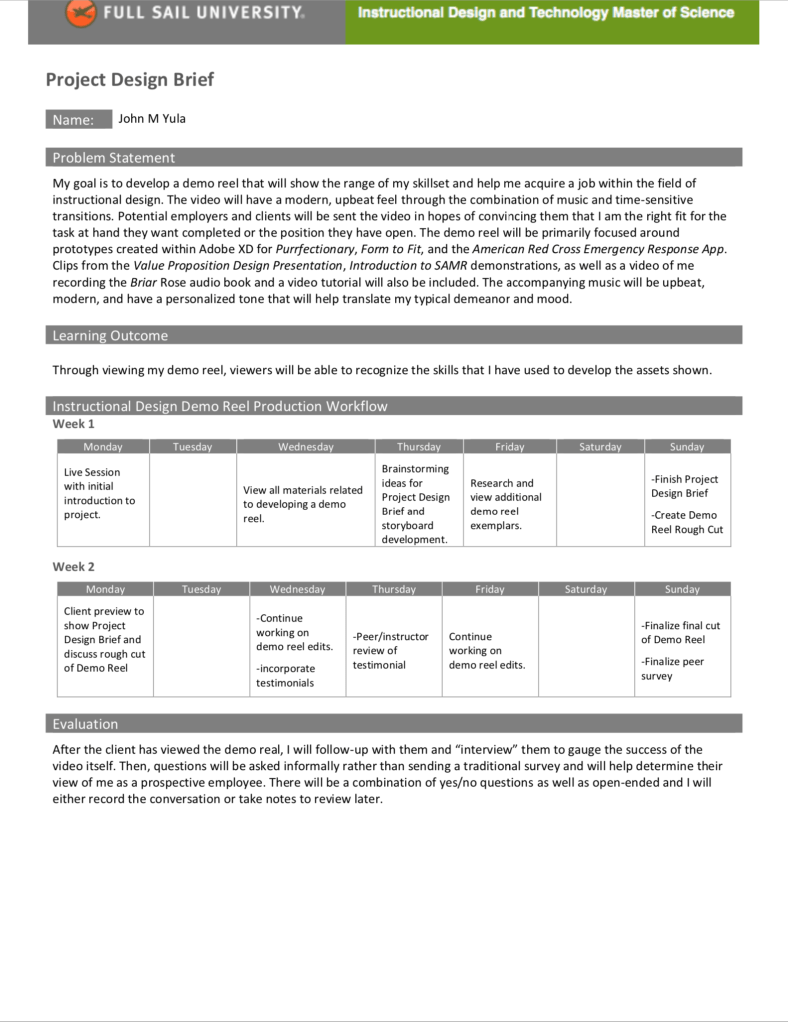
First draft of the Project Design Brief for my demo reel.
Demo Reel Rough Cut

Next Steps

Moving forward, there are numerous edits that need to be made before the demo reel is complete.

  • Replacing placeholders with appropriate footage.
  • Recording the video of my “recording” the audio book
  • Altering the title and ending slides
  • Including caption bars that have a title of the project and/or the programs used to develop the asset
  • Fixing the emergency response app portion of the demo reel
  • Editing the music/visuals to match timing wise

EME6600 Course Reflection

What would you do differently? What would you keep doing, stop doing, and start doing?

Over the past month in EME6630: Learning Management Systems and Organization, I obtained an extensive amount of base knowledge about Learning Management Systems (LMS), their different forms, and possible applications. As I have throughout the entirety of the Instructional Design and Technology Master’s (IDTMS) program, I would approach each assignment and topic with my perfectionist and thorough nature. Sometimes, however, this leads me to take more time on assignments than needed. For example, I misunderstood what should be done for one an assignment in which we had to develop a content map. I developed a heavily visual content map through both paper and digital methods only to discover that I had done it entirely wrong. Additionally, my focus has been diverted between life, work, the course, and circumstances surrounding COVID-19 causing me to not pay attention to as many details as I should. Normally I read all of the assignments for the course at its inception, as well at the beginning of each week. I took a more relaxed approach during this course and I shouldn’t have. For the remainder of the program, as well as any future projects I undertake, I will be sure to be as thorough and detail oriented as I typically am.

How can you make your situation better? 

In order to improve my current situation, I must approach each project with the same tenacity and thorough nature. Throughout my educational career, both professionally and as a student, any and all success that I have seen has been due to me putting all of my effort and creativity into it. While I have seen some success while taking a more laid-back approach, I feel uncomfortable throughout the process because I know that I can put more effort into the project. I have yet to find a happy medium, which is something that I need to do in the future as my family will always be my first priority, but I still want to be as successful as possible professionally.

What sacrifices would you have to make to ensure that you, as a graduate student, more fully engage in and fulfill all assignment/project requirements in a timely manner?

As a graduate student I need to make sure that I fulfill all project requirements to the best of my ability and exceed my clients’ expectations. In order to do this, I will have to make some sacrifices, similar to those I made throughout the IDTMS program. I have had to reduce the amount of time spent doing leisure-based activities as well as how much time I have spent with those other than my wife and child. I want to make sure that I have a healthy balance in the future between work and my personal life. That being said, I recognize the time and dedication it takes to be successful in any industry, especially Instructional Design.

Developing a Content Map

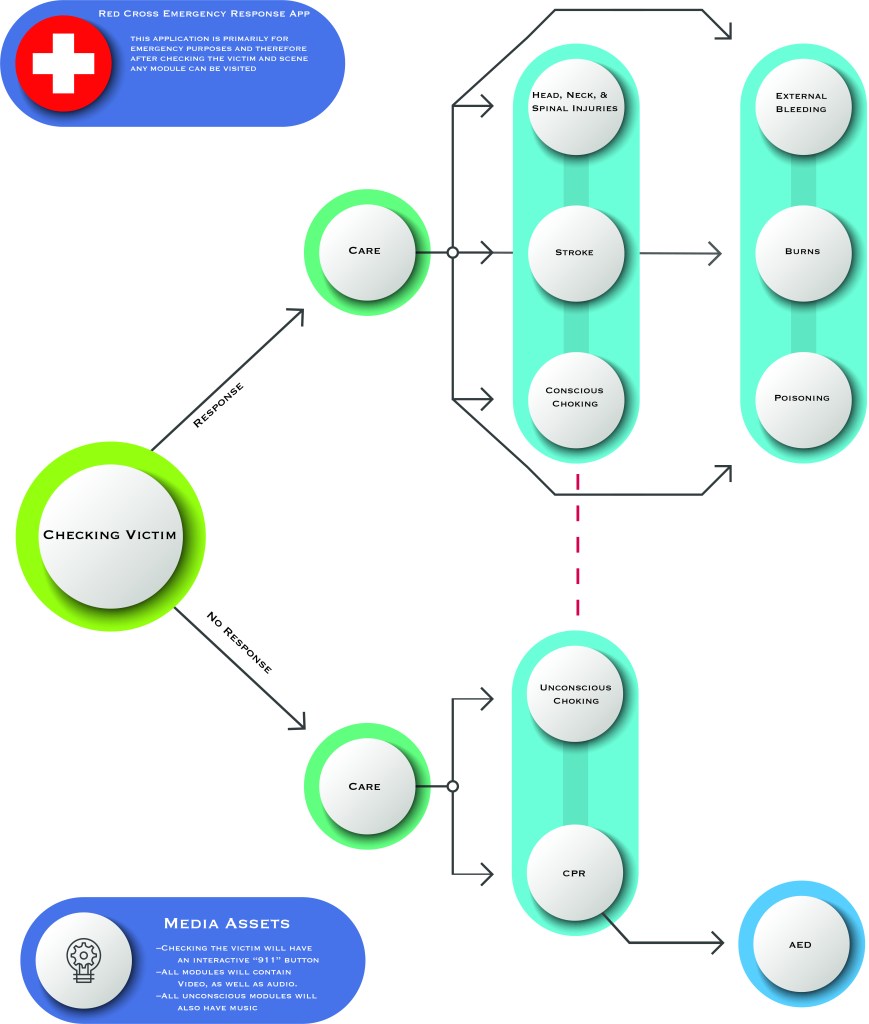
The content map that I developed is for an app based around the American Red Cross’s First Aid/CPR/AED ready reference document. The primary function of this application is to help guide anyone through an emergency situation. When designing the content map, this was taken into consideration as it alters the format of the document. Unlike trainings or courses based around the same subject matter, the information is free flowing and can be access in any order, with the exception of checking the victim and evaluating the scene. I wanted to make sure that the content map was as simple, and easy to understand as possible. Having text accompany the different modules would slow down the response time of anyone using the app for its intended purpose, therefore audio and video are the primary means of transferring information.

The app itself would allow the user to complete training modules, each one preparing them for the associated emergency situation. After completing each module and its associated knowledge test they would earn badges. Initially, I developed a content map for the app itself, rather than its training portion to help create a visualization of the free-flowing nature of the app itself.

Initial content map for American Red Cross app.

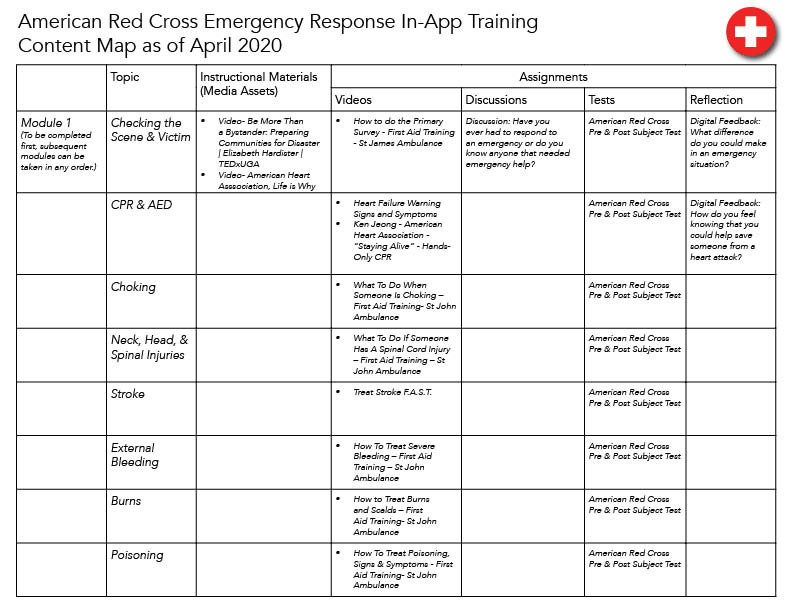
After discussing my ideas with my professor and classmate more, it was determined that a more traditional content map should also be developed, specifically for the training portion of the application. The content begins with “Checking the Scene & Victim”, as that is the first thing that should be done in any emergency response situation. Users are presented with videos introducing them to why it is important to obtain the knowledge within the app. They then are provided videos covering what to do in any given emergency response situation. At the end of the module there is an assessment to check and make sure that they are prepared for that specific situation.

If I were to move forward with the development of the app I would create my own videos as many that are available are older and can be enhanced relatively easily.

Content map outlining in-app training for American Red Cross emergency response app.

Form to Fit- An Interactive Fitness Game

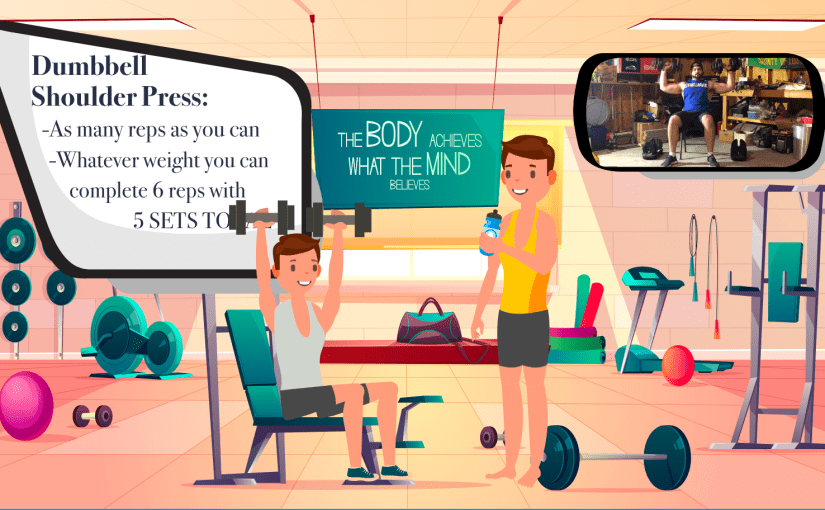
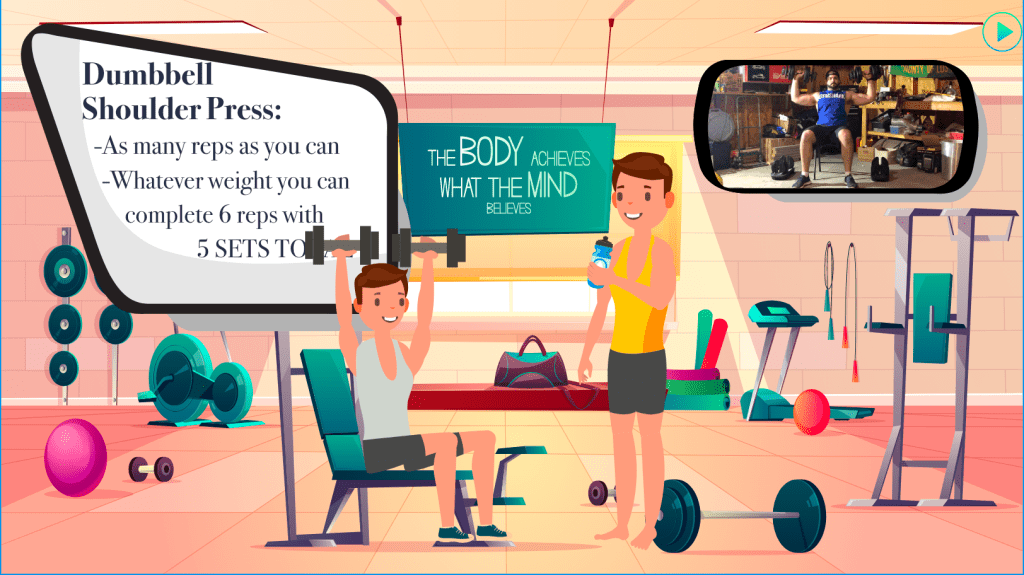
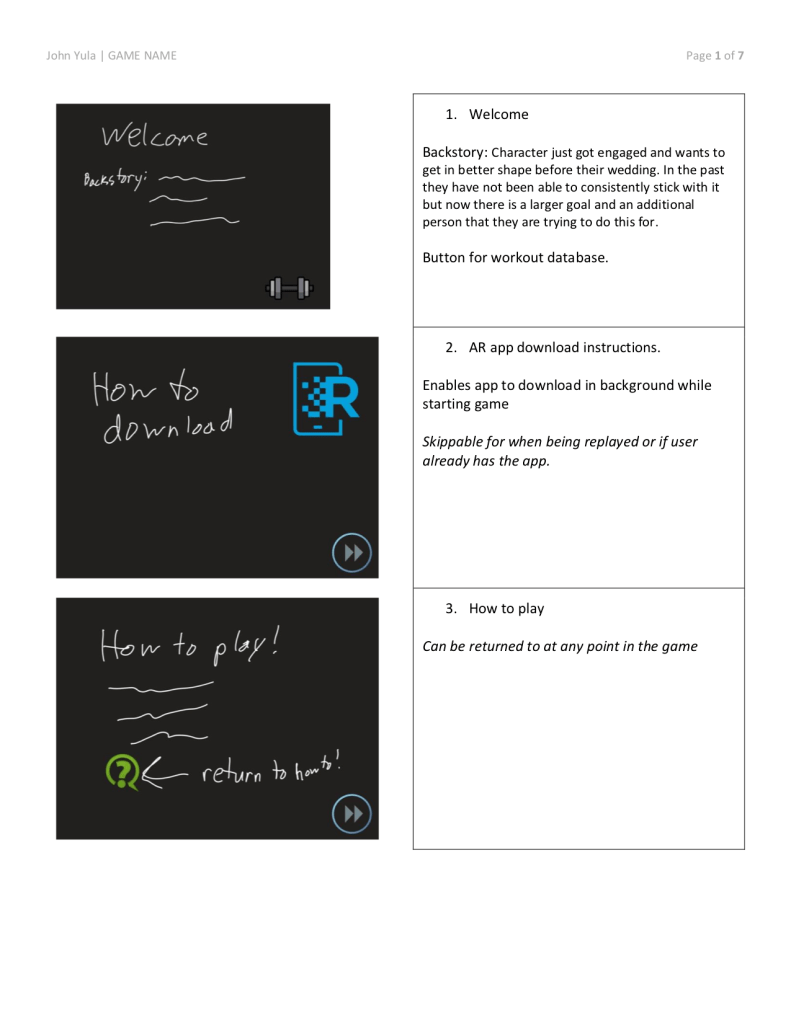
Game image from Form to Fit

Reflect: (Recall, ponder, and articulate)

            The process for creating a game was not easy. The hardest part of the entire process was coming up with the idea for the game itself as I wanted something that would be applicable for life after the Masters program. After deciding on the subject matter, I was able to take the idea and run with it. I hit a major roadblock when one of the technologies that was a basis for the game, HP Reveal, had been discontinued by the company. This caused me to reflect on other ways in which I could make the game work, and possibly even improve it. Without having augmented reality as an option, I was able to delve more deeply into the game itself, while still leaving the possibility of future incorporation. I am extremely excited and proud of how my XD prototype turned out. 

Inquire: (Seek information and provide ideas through questioning)

            In attempting to find out a directly profitable client, in addition to the average user, I have come up with multiple options for how my game could be marketable. The first idea that I came up with is having gyms use the game as a form of orientation to new members. Since it is in the form of a game, as well as being visual, it is more appealing to its members than verbally telling them or providing them with a packet of information. Another option I considered is providing a link to the game through a QR code. This could be useful for supplement companies in particular who could put it either on the inside lid of their product, or the back of it. By encouraging good form they are not only improving their company’s image but also helping to ensure that their customer prevents injury which, in turn, means they will be able to continue buying their products. I hope to see if there is a possibility of my local gym implementing my game as a pilot to receive feedback for improvement.

Suggest: (Introduce ideas for improvement of CURRENT iteration)

            The current iteration of Form to Fit can be improved primarily through more graphic work. In the game’s initial development, I tried to customize as many of the screens as possible and alter the character design to reflect what was happening. Due to the sheer volume of screens and options I included I was unable to alter the character designs as much as I would have liked. Including a wider variety of ending screens is also a possible enhancement to the current iteration as I tried to simplify it as much as possible to streamline the overall ending message.

Elevate: (Raise to a higher degree of purpose in FUTURE iterations)

            For future iterations of Form to Fit I would like to develop more instructional workout videos further increasing the overall size of the video library. I would also like to create the augmented reality portion that was initially conceptualized. The trigger images for the augmented reality, as well as QR links to the videos, would be placed at local gyms, parks, and fitness centers. Having the videos play directly within the game would also be a major upgrade as that is not currently possible in Adobe XD. 

This video provides an overview of Form to Fit as well as examples of it in use.

A Deeper Reflection

For my Master’s class, IDT574- Digital Media and Learning Applications, I was tasked with creating an assessment based off of an informative NASA video. This assessment was to be coded using Brackets and would ultimately be part of a larger lesson for high school students.  This video was created to show how the assessment worked alongside the associated NASA video on black holes. 

Reflection

As a part of reflecting upon my previous work, I will be utilizing the RISE model for self-evaluation by Emily Wray (www.emilywray.com/rise-model). 

Reflect- Recall, ponder, articulate

Looking back at my interactive coded assessment and the accompanying video I feel as though I created an excellent final product. Learning a new program and how to utilize code in such a short period of time was challenging, yet regarding.  Any obstacles that I encountered or questions I seeked help from peers, as well as the Discord at Full Sail University. Many of these issues were solved, but I was unable to figure out how to get an image from Adobe Illustrator to link, despite following all of the tutorials and information I received. My work-around was creating an image that looked extremely similar to utilize instead. 

Inquire- Seek information and provide ideas through questioning

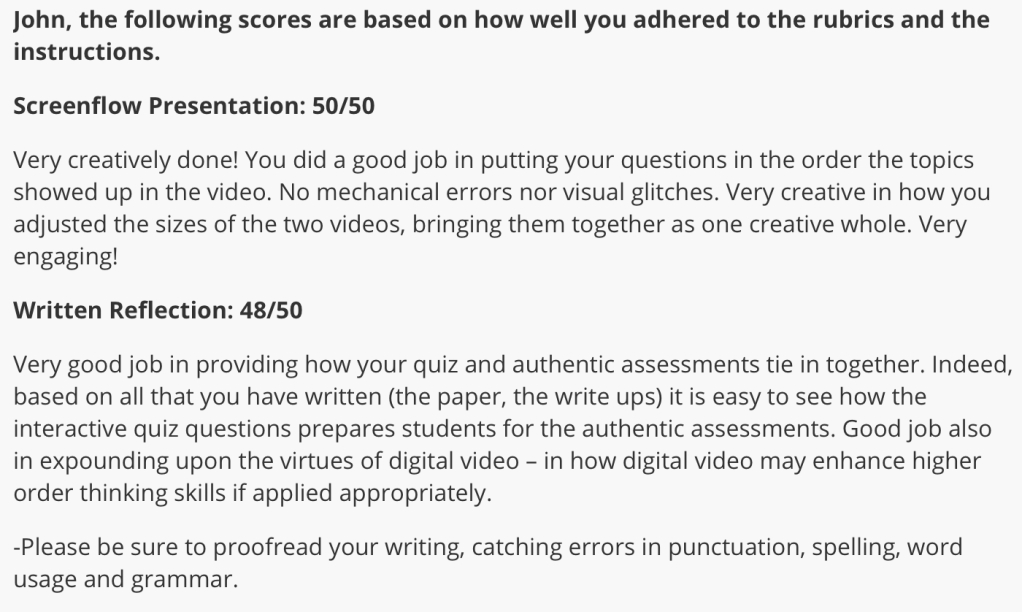
After the assignment was completed I received feedback from my professor. Based off of the feedback I received, there are not many changes that could have been made to improve the quality of my work. I am always extremely diligent throughout the creative and production process to ensure that the final product is something that I can be proud of. 

Feedback received from my professor

Suggest- Introduce ideas for improvement of CURRENT iteration

Not much would have changed if I had more time for this project. I am have been able to find a solution to my problem of an image not linking but I think my work-around turned out great. The only other change would be to go back over my writing with a fine-tooth comb to make sure there are no writing errors, as suggested by my professor’s feedback.

Elevate- Raise to a higher degree or purpose in FUTURE iterations

For future iterations of this type of project, I would like to spend more time with the program, as well as more robust programming formats. While I feel as though this is an excellent tool, there are limitations to what I was able to do. A more involved program would provide more options and opportunities to produce an even higher quality work. 

Coding an Interactive Quiz

Throughout my educational career, I have always taken pride in my ability to diversify the lessons, assignments, and assessments I create. I was extremely excited when I found out that I would be undertaking an assignment in which I was required to code an interactive quiz based off a video. I have taught numerous classes in which I followed the flipped classroom model and being able to create my own interactive quiz based off a video would have been incredible.

The Process

  1. To create the questions for NASA’s video on black holes I watched the video numerous times as well as reading through the accompanying transcript. I first wanted to make sure that I acknowledge the major myths that exist surrounding black holes. Then, I wanted to make sure that learners would be able to identify the reasons as to why the common myths exist. Additionally, these questions were designed to help provide a foundation for the research learners will continue after completing the video.
  2. The authentic assignments have been designed to build off of the interactive quiz directly. By providing a foundation of information it will be easier for learners to complete research and then transfer this information to others. Not only does the authentic assignment require the development of research skills, but also the organization of that information into clear and concise thoughts. Following their presentation learners will also utilize augmented reality to enhance the transfer of information in ways not otherwise possible.
  3. The use of digital media enhances higher order thinking by enabling learners to learn through the use of the video as a resource. By combining this learning object with the text-based resources both left and right brain cognitive skills are engaged. The digital nature of the learning objects also enables greater access to learners through its versatility. The video can be rewatched as a whole, or specific parts can be viewed again if clarification is needed. Additionally, the interactive quiz and associated video are excellent resources for any flipped or online-based educational environment.

Measurable Learning Outcome

Students will be able to explain to others what the differences are between the myths and reality in regard to black holes as well as give reasons as to why those discrepancies exist.

SWBAT Objectives

  1. Identify three “facts”/myths associated with black holes.
    • The identification of perceived black hole facts encourages students to recall previous knowledge related to the subject matter.
  2. Investigate why black holes are so misunderstood.
    • After watching the video, students will begin to use various technological resources to research and investigate the discrepancies between what they thought they knew and what is actually the truth. This objective specifically encourages the use of both left and right-brain cognition through the use of media and text resources (Gunter and Kenny, 2004). 
  3. Explain what the differences are between black hole myths and facts as well as give reasons why these discrepancies exist.
    • Utilizing their research and findings, students will be able to transfer the information to others. According to Gunter and Kenny (2004), this type of activity is possible through learning with technology rather than from it and the higher order thinking which it encourages.
Video Demonstration of the Interactive NASA Black Hole Quiz

Authentic Assessments

These authentic assessments are designed as follow-ups to the NASA video and associated interactive quiz.

  1. Investigate and compose research on black hole and why common misconceptions exist. (objective 3)
  2. Create a Pecha Kucha presentation explaining at least two of the myths that exist surrounding black holes and why they exist. Record the presentation. (objective 3)
  3. Create an augmented reality (AR) experience utilizing the pre-recorded presentation. (objective 3)

Looking back at the feedback for IDT522: Corporate Training and Motivational Development

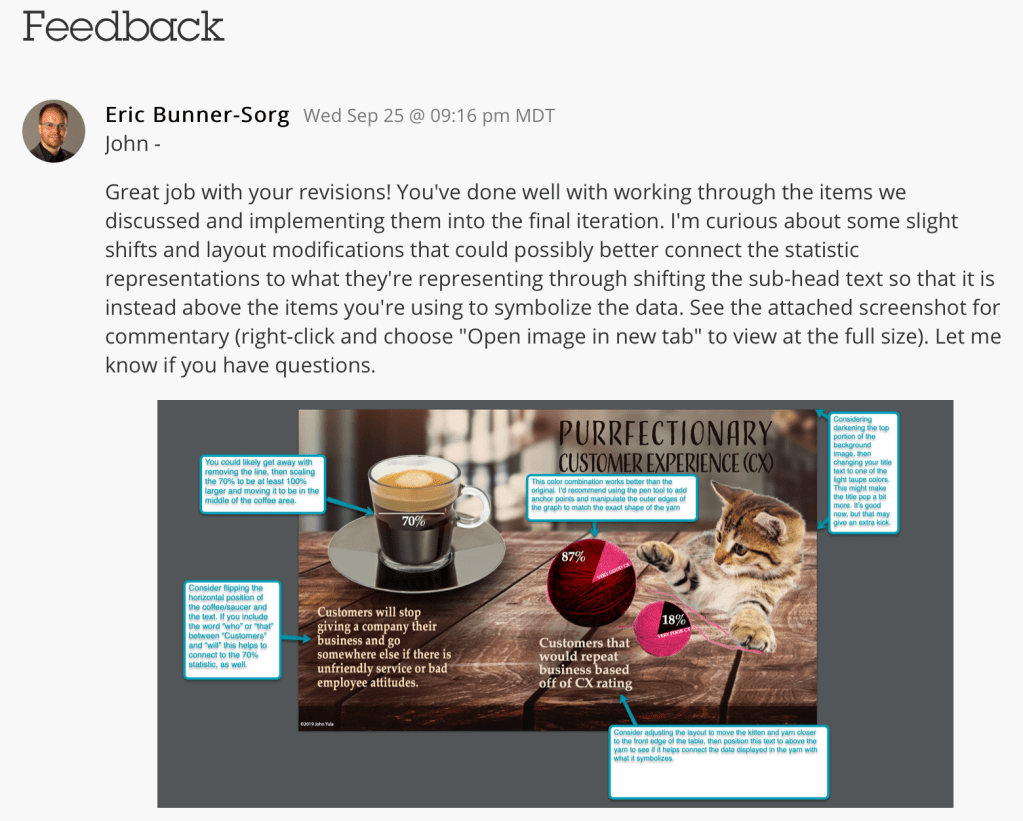
The course this past September was IDT522: Corporate Training and Motivational Development taught by Professor Bunner-Sorg. This class in particular helped me to grow not only my skills and knowledge, but also my work methodology as a person. Typically, I get extremely stressed out about every single detail and want my initial draft to be the same quality as my final. Having Professor Bunner-Sorg for two consecutive months also helped me to build a relationship in which I felt extremely comfortable reaching out for feedback, clarification, and assistance. For example, the infographic I designed for the hypothetical company Purrfectionary, was one in which I had multiple private sessions to discuss my thought process, struggles, and possible options moving forward. The final feedback acknowledged the improvements made through our discussions as well as future changes that could be made to improve the design even further.

Feedback received on my Purrfectionary infographic.

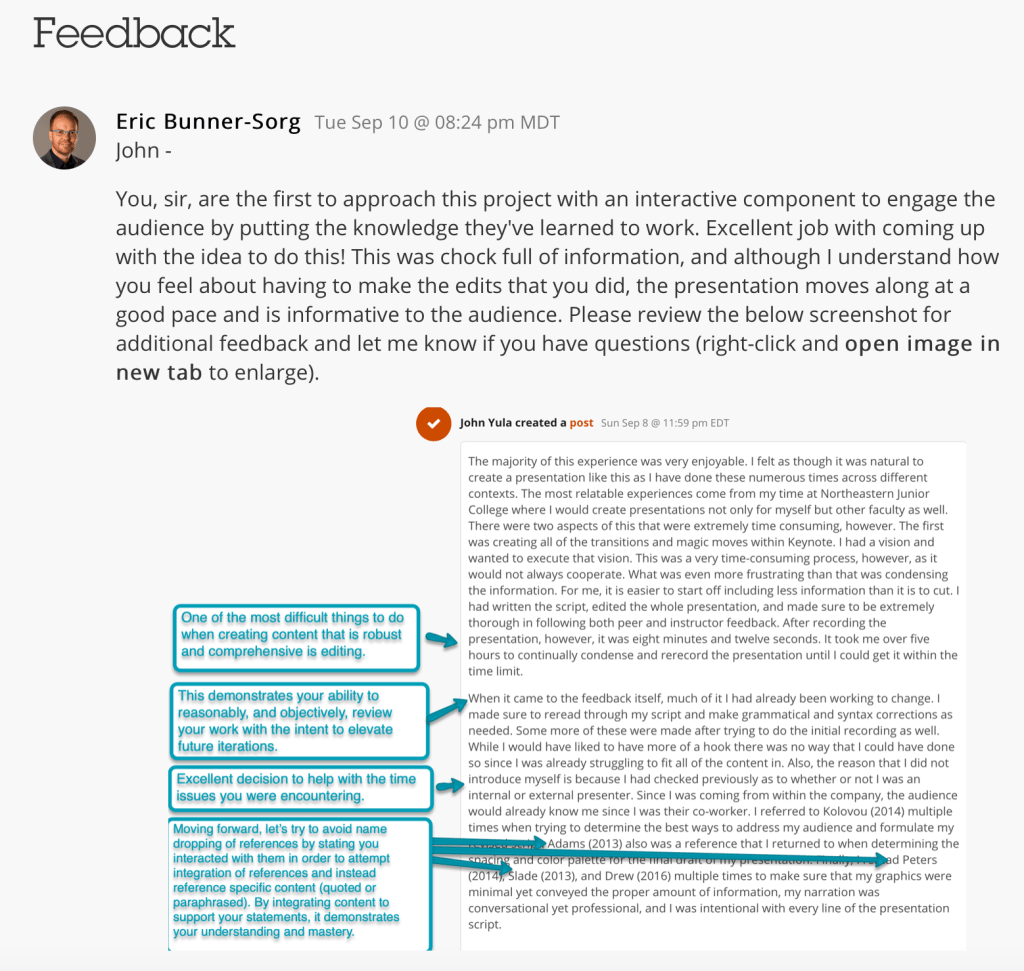
Throughout this course, the most helpful things to me were not only Professor Bunner-Sorg’s openness, honesty, and availability but in particular the video feedback he provided. It gave greater insight and felt much more personal. For example, the video feedback provided for the Understanding Client Needs Draft assignment helped my project to develop and grow, subsequently enabling me to see even greater success in the final presentation.

Feedback received for the Understanding Client Needs in which I created a presentation based around Value Proposition Design.

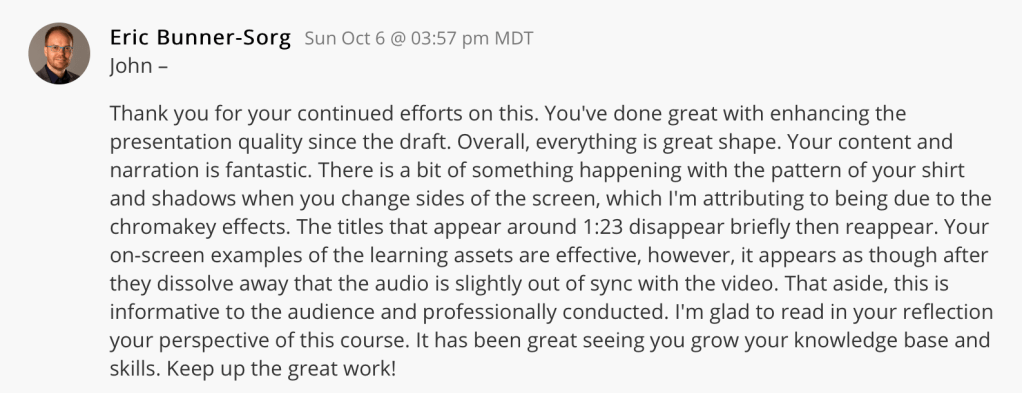
I plan to incorporate all of the feedback the I received from Professor Bunner-Sorg back into my projects, especially the final presentation for the class in which I took some risks utilizing a green screen. His suggestions will help fix the technical issues that I had and make it flow much more smoothly.

Feedback I received on my final presentation for IDT522.

All-in-all, I feel as though all of Professor Bunner-Sorg’s assignments had a purpose and showed a broad range of skills which could be extremely valuable in a future portfolio. 

Project Design Brief Presentation

Over the course of this past month I learned a lot about the corporate training environment. Up to this point in the program I felt as though the new content I had been learning was relatively sporadic. This month, however, all of the content was new to me and I felt as though I got a lot more out of it. In fact, I enjoyed this month much more than I thought I ever would have given the subject matter. Initially, corporate training sounds extremely boring but I have not enjoyed anything thus far in the master’s program so much. 

            One of the aspects that I enjoyed so much was the challenge of having to create a variety of resources for a potential client. The ability to have freedom in developing a backstory also help me feel more invested. As everything progressed all of the different elements seemed to build off of each other and I incorporated various elements learned thus far throughout my classes. One of the greatest influences ended up being Peters (2014) as I consistently referenced to principles he outlined. For example, when creating my infographic and modifying it I made sure to chunk information to help reduce the cognitive load. As I transitioned to developing my interactive eLearning module, I wanted my feedback to be more organic so I designed it to be more of a experiential learning process. In addition to this, I utilized various educational theories and pedagogical concepts when conceptualizing and creating the materials for the training. In particular, I used a combination of Substitution Augmentation Modification Redefinition (SAMR) and Bloom’s taxonomy to create a more comprehensive learning experience (Puentedura, 2014).

            The final presentation was relatively easier to script. I made sure to start the presentation out with a strong hook to engage and pique the audience’s interest (Shari Harley, 2008). As I continued to run through my presentation I felt as though it was boring, so I referenced back to other presentations that we had watched and remembered what Kolovou (2014) suggested when it came to physicality, movement, and hand motions. After considering these elements I decided to incorporate these into my presentation more. The most difficult aspect of the presentation’s development was the editing. Since I decided to incorporate the use of a green screen, I attempted to do this through iMovie, Adobe Premiere, and Screenflow. Each had their own advantages and disadvantages. Without a doubt Premiere is the best software of the three but my lack of knowledge caused it to be way to inefficient timewise. Screenflow became eliminated in my process when it continued to decrease the quality of the video, so I ended up using iMovie. Despite the issues with not being able to create layers and greenscreen multiple items at once I worked around this through exporting multiple versions, creating new projects, and importing assets I created in Adobe Illustrator. While I am happy with the final product, I would eventually like to learn adobe premiere and reedit everything through there. Without the amount of knowledge and skills I acquired over the course of the past month this project would not have been possible and I feel as though this class benefited me more than any other I have taken thus far in the program.


Project Design Brief Presentation

References

Kolovou, T. (2014, June 27). Creating and giving business presentations. Retrieved from https://www.lynda.com/Business-Skills-tutorials/Presentation-Fundamentals/151544-2.html

Peters, D. (2014). Interface design for learning: Design strategies for learning experiences. San Francisco, CA: New Riders. Retrieved from https://ce.safaribooksonline.com/book/web-design-and-development/9780133365481/8dot-multimedia-and-games/ch08_html

Puentedura, R. (2014, September 24). SAMR and Bloom’s Taxonomy: Assembling the puzzle. Retrieved from https://www.commonsense.org/education/articles/samr-and-blooms-taxonomy-assembling-the-puzzle

Puentedura, R. (2011, October 27). SAMR and change [Blog post]. Retrieved from http://hippasus.com/blog/archives/56

Shari Harley. (2008, August 20). Presentation skills – Corporate training [Video File]. https://www.youtube.com/watch?v=mTijtdjzg8U

Attributions

Adobe Stock:

  • Cafe shop Restaurant design Minimalist Loft,Counter wood slat,Top counter metal,Mock up on wall concrete,Menu board on wall back counter brick,concrete floors -3D render—file #267273685

Creating my first eLearning module

Previously for my class entitled Visual and Verbal Communication in Instructional Design I had to create an infographic. The prompt for this assignment was that a group of fourth graders had just discovered that they were unable to go on a field trip due to lack of funding. My infographic, and eventual eLearning module, were going to help serve as replacements for the field trip. When I developed my infographic, I did so with the eventual eLearning module in mind. I know that I wanted students to learn the process of a bill becoming a law. This made the translation from static images to an interactive eLearning module much easier. The information initially presented on the infographic was much more basic but was intended on piquing interest in the content despite their disappointment. 

            Throughout this course we have learned to incorporate various learning principles into our work to help ensure the best learning experience possible. A couple of foundational principles that I constantly tried to utilize were reducing cognitive load through following the stages of learning and chunking information (Driscoll, 2018). Their ability to interact with content enhances their ability to retain information as supported by the Substitution Augmentation Modification and Redefinition (SAMR) Theory (Puentedura, 2011). Once interactivity increases then higher level thinking does as well. Much of the content that is created does so through storytelling, which also helps to connect learners with the information making them feel more invested (Jantakoon, Wannapiroon, & Nilsook, 2019). It has also been much easier to create content knowing when to use conversational language as opposed to being more formal (Drew, 2016). 

            Up to this point in my Master’s program I have learned some valuable lessons and developed my skills. In order to complete my eLearning module I made sure to incorporate the concepts through various learning theories while trying not to try to do too much. Both Peters (2014) and Slade (2013) became constant references for me as I used their research and information to guide how I organized my content visually and practically. Many of the tutorials helped me grasp more design principles that, in actuality, better prepared me to translate content as intended. The most valuable of these was Trani’s (2018) tutorial on Adobe XD as this has become my favorite software to work with. It feels extremely natural and fluid and while I may have been able to figure out some of the techniques on my own, he helped expedite the process. Overall, I feel very comfortable with where I am at thus far in the program and look forward to whatever comes next.


Here are links to both my eLearning module and me walking through its usage.

https://xd.adobe.com/view/55cc2422-13ec-43ea-74da-f31458654cb3-23fd/?fullscreen


References

Drew, P. (2016, July 6). Copywriting for instructional design narration and role playing. Retrieved from https://e-learningvoices.com/copywriting-for-instructional-design-narration-and-role-playing/

Driscoll, M. (2018). Psychological foundations of instructional design. In R.A. Reiser, & J.V Dempsey (Eds.), Trends and issues in instructional design and technology (4th ed.) (pp. 52-60). New York, NY: Pearson

Jantakoon, T., Wannapiroon, P., & Nilsook, P. (2019). Synthesis of framework of Virtual Immersive Learning Environments (VILEs) based on digital storytelling to enhance deeper learning for undergraduate students. International Education Studies12(4), 198–207. doi: EJ1211500

Peters, D. (2014). Interface design for learning: Design strategies for learning experiences. San Francisco, CA: New Riders. Retrieved from https://ce.safaribooksonline.com/book/web-design-and-development/9780133365481/5dot-learning-is-visual/ch05_html

Puentedura, R. (2011, October 27). SAMR and change [Blog post]. Retrieved from http://hippasus.com/blog/archives/56

Slade, T. (2013, July 6). Writing styles for elearning narration. Retrieved from http://www.tim-slade.com/writing-styles-for-elearning-narration–jul.-6,-2013.html

Trani, P. (2018, February 15). Designing and prototyping a website with Adobe XD. Retrieved from https://www.lynda.com/Experience-Design-tutorials/Designing-Prototyping-Website-Adobe-XD/586674-2.html